
Hollow Knight: Silksong
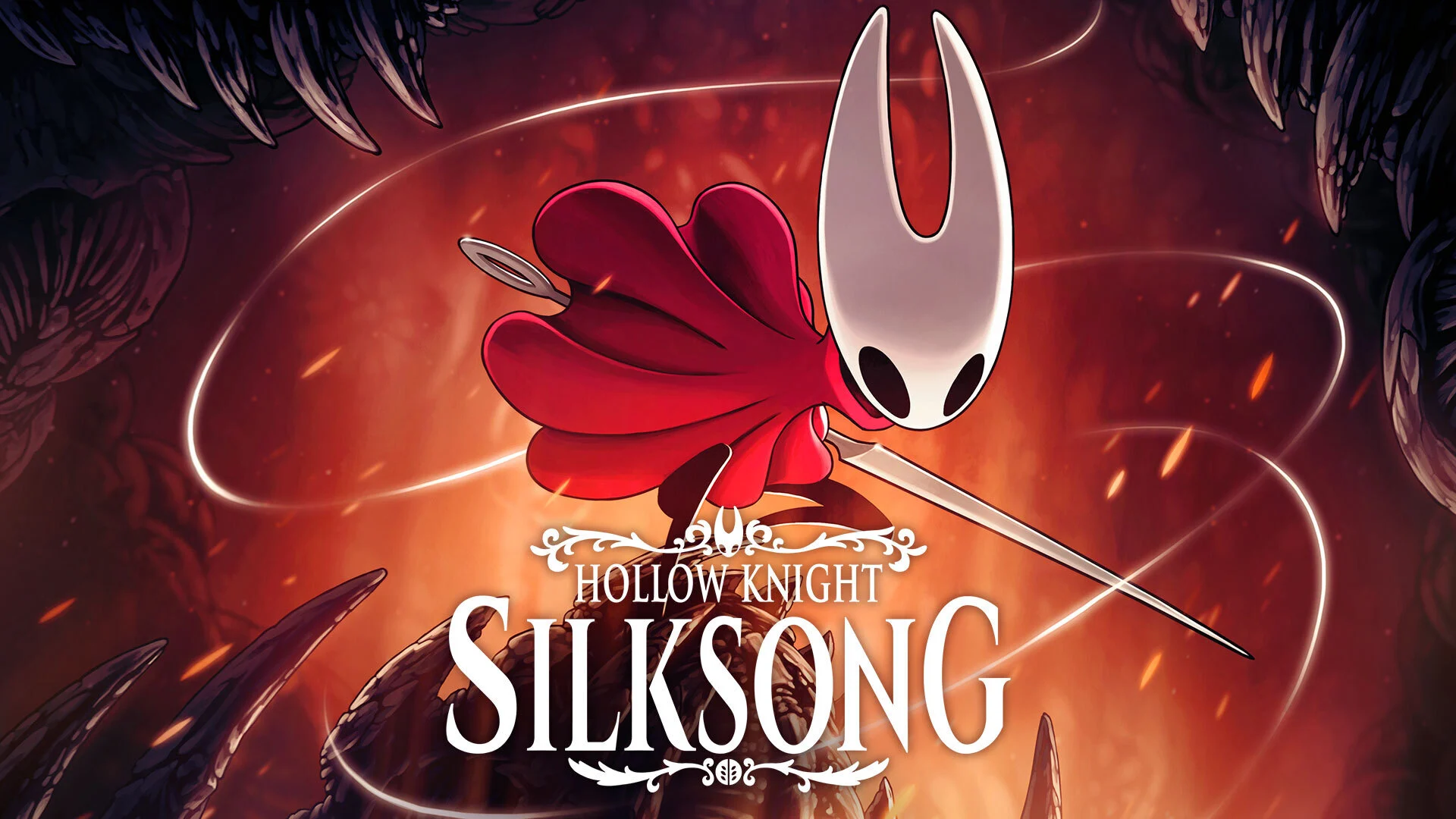
Hollow Knight: Silksong, Team Cherry, 2025.
Typical opening quote (very overused), 30s intro and straight to Gameplay. Much better.
Room where you can try the controls without rushing and you need to know how to attack to unlock the door. Nice.
The controls are incredibly responsive: instant jump with a lot of sensitivity, attacks that come out fast but have slightly longer recovery, the downward hit in the air is a dive kick… You can grab onto ledges to climb up to platforms and if you jump at the same time she does a flip where you can control the direction, giving you a lot of freedom of movement. Agility is what comes to mind when I think about these controls.
It has the same mechanic as Hollow Knight where you heal using a mana bar that you fill by fighting. Fully aggressive. I remember back then it reminded me of Bloodborne.
First bench to save the game, an important checkpoint:
First boss fight. Practice with spacing, jumping and attacking. If you master the dive kick it becomes much easier. It spawns small enemies that you can use to heal.
Dialogues have a small icon at the top in the center so you know who’s talking. Hornet does. Thank goodness.
More depth in the controls: if you press jump and down-attack at the same time, it does the dive kick from a slightly higher position than you actually were at. You can tell they know what they’re doing.
I didn’t remember the characters being that charming :) There are a lot of them that sing.
So far there are two currencies: shards, which I still don’t know what they’re for (I imagine crafting) and are found “in the wild”, and rosary beads, which are basically money and are found in spots (that someone has placed) and in “humanoid” enemies, and are used to buy items. The way they fall, roll on the ground and you have to pick them up one by one gives them a touch that makes them feel more valuable (or makes you feel poorer). It also feels like you lose them when you die, and making the first merchant string them into a single rosary so they don’t get lost works like a bank.
Speaking of that, maps work like in the previous game: you have to buy them. What’s more, the compass, markers and filling in visited areas also have to be bought.
The compass is a tool you have to equip in the “yellow” slot (navigation, miscellaneous?) when resting at benches – like charms in the old game. It also looks like you can equip other types of tools and one ability. They really know how to handle pacing and build hype.
Now tabs have appeared in the UI for map and tools, being added slowly and generating anticipation. Like I said, they know how to build expectations.
Shortly after getting the map there’s a section that looks unreachable, but if you drag a flying enemy next to you and bounce off it, you feel very smart and you’re duly rewarded with a (very good) shortcut and a silk (mana) upgrade fragment.
With the first ability, the webs that can only be removed with it let you recharge it if you hit them with melee. This solves the problem of getting stuck.
I suspected it from the change in perspective but now I’m sure: the environment has 3D elements that look extremely 2D, and only the slow change in perspective lets me notice it. The shader is spot on, I don’t know how they’ve done it. I think it’s actually a matter of multiple 2D layers that, with a perspective camera, create that feeling. It’s a mix: the altars that grant abilities are 3D and other elements are 2D layers that, with parallax, give that sensation.
The attack tools work like the Delito: you equip them at a bonfire/bench, they have a limited number of uses and they’re refilled when you return – in this case, they consume shards.
The places where upgrades appear feel a bit arbitrary, at least at the start. I just go into corridors and suddenly there’s an upgrade.
The sprint and dash upgrade is insanely good to control: fast and precise. You just have to be careful with the bursts of speed. Really looking forward to seeing speedrunners use it.
In the area where you have to bounce on flowers to move the platforms, using the D-pad is much more precise, since the level design is built around 8 directions, like Celeste. Fighting, on the other hand, is better with the analog stick, like in Smash Bros.
I didn’t remember the bosses having so few patterns. The first boss has 3? attack patterns. The one that serves as transport has 3 attacks in phase 1, which get one extra projectile each in phase 2, plus an attack exclusive to phase 2. The mini-boss for the Hunter’s Mark only has 2.
There’s a slightly weird dissonance in the difficulty of some bosses: more than mechanical, it’s that they take 2 hearts and you lose in 3 hits or mistakes. For example, with the beast that transports you, the fight is simple but a bit long and I’ve died several times more because of that than because I failed to dodge, when up to that point the game was honestly pretty easy.
If you look at the deers that jump over the fire without getting hurt, they’re a hint about the sprint.
If you attack at the same time as another enemy with a sword or similar, both attacks are canceled in the form of a “parry”, like in Smash Bros (although in the latter it’s much harder).
To be able to equip more tools, you have to get some items that increase the amount you can equip in a category, but you have to choose which one.
Hitting the cocoon where you died also generates a lot of silk – a good comeback mechanic.
In an area where you seem to get stuck, they ask you to kill some enemies to get ingredients but you don’t know which enemies just from the name. They don’t even describe them. And the name sounds arbitrary.
Wow, and on top of that you had to hit the spikes they throw. Up to now nothing has been interactable in that sense. It took me a while to make the connection. Honestly, it was mostly luck.
The giant boss with the very spectacular foreshadowing (they’re very good at this). I was surprised it has 3 phases instead of 2, even though it only has 3 attack patterns which, again, add falling chunks from the ceiling in later phases to complicate things. The fact that it destroys the platform you’re fighting on is fun and forces you to be agile and use the new upgrade (which I forgot about), although it’s also true that sometimes the ground smash destroys more areas than it seems – maybe because in later phases it affects more? I lost because of that. This boss only takes one heart per hit and it’s much more fun. The difficulty lies in agility and anticipating its attacks, not in it having tons of health and you making mistakes that cost you 2 hearts.
I died in the middle of a platforming section full of spikes and instead of the cocoon appearing at the beginning it was way further ahead, where I couldn’t pick it up. So annoying.
Side hunting quest with tracking and everything, reusing earlier levels in a very interesting way, and it can also help you explore areas you’d missed.
There’s a special section of very long platforms where you get a breather with small enemies trapped in cages (very on-theme) so you can charge your healing ability. Very well thought out.
Mosquito boss is pretty monotonous. In the end it’s so long that you make mistakes and it takes 2 hearts, more because of the length than the difficulty of the fight itself.
When you defeat it, you get a new crest that lets you change both your main attack and your healing ability – in this case you attack with claws and enter a mode that steals life when you attack – and it also has a different number of tool slots you can equip. The reward feels really satisfying though: probably the hardest fight so far, to unlock horizontal progression rather than vertical. I wonder how effective it’ll be to swap it in for specific bosses.
It’s also a vector of progression for the memory lockets that increase the number of tools you can equip.
When you unlock the climbing ability, right after that there’s a very tough boss that, once defeated, lets you upgrade your weapon. The new ability lets you reach many places you couldn’t before, but it requires backtracking to older parts of the map which is kind of a slog, although with the higher damage, fights in old areas become much easier.
The game uses the quest system to make you revisit earlier areas so it doesn’t feel so heavy, and also to give you extra rewards as you explore them with the new abilities.
Target minigames that give you ammo upgrades in pure Zelda style – yay!
The way you get maps in the citadel is a bit… weird. Feels like they couldn’t come up with anything better. Not very imaginative.
Several hours later I discovered that the bell quest works with RNG. What a nightmare.
I think by doing the flea version correctly, the caravan has moved to a place where there should be a boss fight, and now I can’t complete the detailed enemy list.
Simple enemy that imprisons you – I killed it the first time in that situation, but it showed up again and this time I let it capture me. It sends you to the other end of the map where you’re imprisoned and they take all your items – I always like when games do that. They force you to move more stealthily and avoid fights, and even use traps to kill a bunch of enemies in an arena (very cool). You have to go through some cold sections, running to the next bonfire, which luckily is fairly brief, until you reach the fight where you get your items back and can take revenge: that feeling is great. Nothing new, but I always love it when games execute it well. In exchange, you unlock some keys and a new shortcut to an area that was very hard to explore before.
I think the game overuses really brutal areas where it’s very hard to heal: wormways, the prison, Blasted Steps, Underworks, Sinner’s Road… It’s a way of creating difficulty that can feel tedious and, in my opinion, should be used more sparingly. Better to complicate the game with other factors more tied to the mechanics themselves.
I do have to say the other way to get rid of the larvae that drain your silk is good: you quickly charge the silk bar to be able to heal and that gets rid of the larvae.
In one wish, progress is shown as 10 marks and in another as a bar that fills by 10% for each item you get (see photo). And on the right it still says X out of 10 collected.
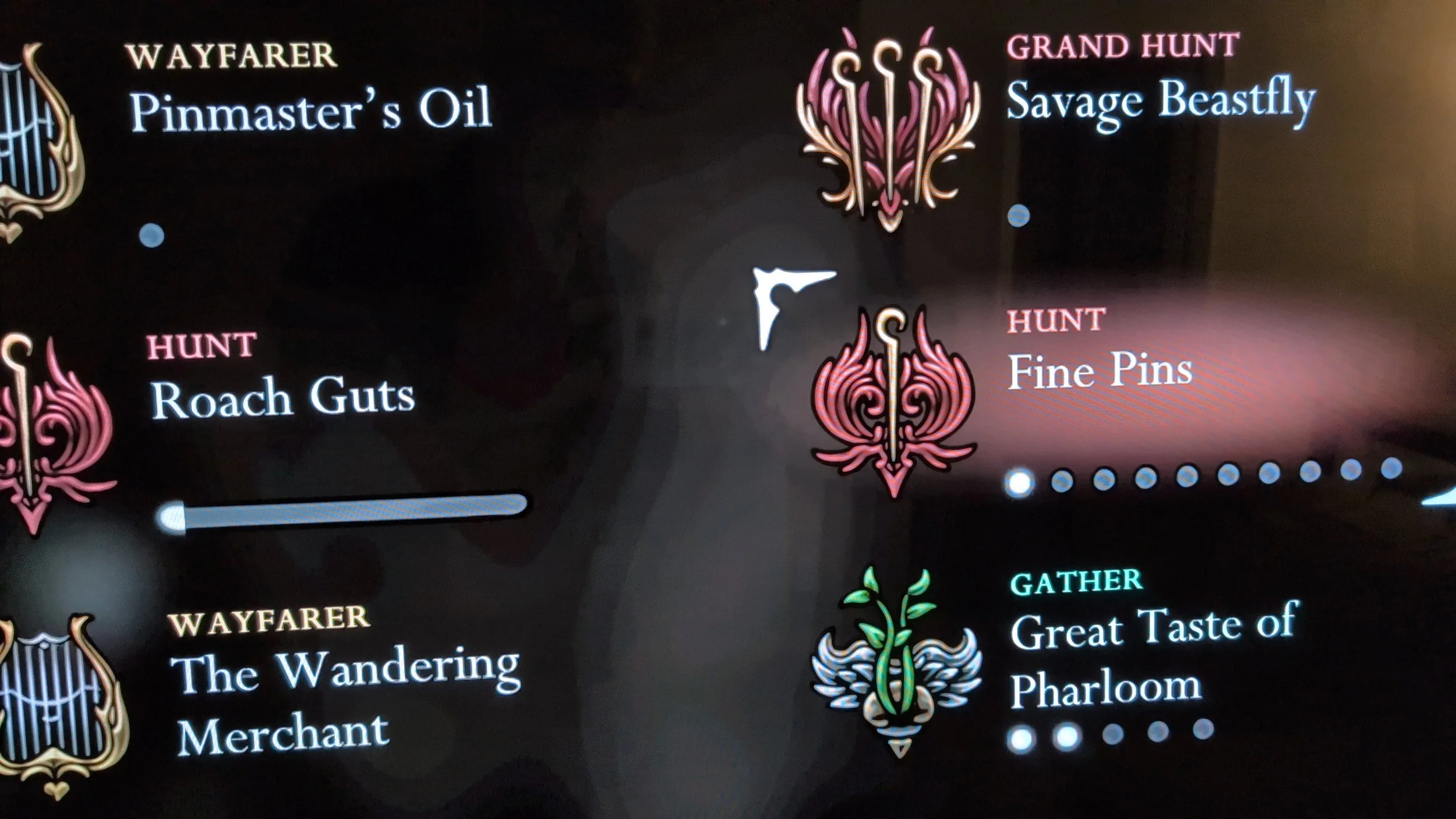
Lack of coherence on how the UI tracks progress
I found out by accident that dashing while you’re clinging to a wall lets you climb straight up without letting go of it, which is awesome. Another semi-hidden mechanic that’s really useful once discovered.
In the High Hall there’s an arena that goes on for an absurd amount of time, probably just so you lose at the last moment. What a slog of a fight; it doesn’t test skill, just endurance, ughhh.
Epiphany: the game feels long to me because in many of the heaviest challenges it’s endurance over skill that matters.
The two mini-bosses at the end of that arena I mentioned take turns attacking so they can’t hit you both at once, or at least that’s how it felt. Which would be fine… except that just touching one of them takes 2 health and they each take up a quarter of the screen.
For the architect’s melody, you have to solve one of the worst puzzles I’ve ever seen: aligning a sort of score across 4 pillars. There’s no reference at all, only one correct answer for each, and what you have to do is start from the top or bottom and keep trying until it lines up with the next one, and if it doesn’t, change it. If at least one piece in each column didn’t rotate, you’d know where to start, but as it is, it’s basically just combinatorics and then common sense. Nothing interesting. This dip in quality really surprised me.
Turns out the next fight was the final battle. Before I even say it, it already reminded me a lot of the one from the previous game; it’s like I’d already done this before. The previous boss felt much tougher and more fun.
You unlock what’s basically the bad ending, classic for them, but this time instead of just unlocking a good ending you have to unlock a whole new act, which I find pretty original; but at the same time, very, very few people will ever see it because, judging from how many things you have to do, it’s a lot of work. Even though, to be fair, the more hardcore Hollow Knight players will absolutely do it.
I went back to the snowy area where I thought you needed to unlock something to avoid freezing and taking damage to be able to keep going, but instead you just had to keep moving forward until almost at the time limit, and then you find a sort of bubble or protection field. I think the level design isn’t great here, because there were no small hints suggesting that was the direction to take: if those force fields had been closer together at the beginning and then further apart, then it would be obvious you had to go that way, but that’s not the case, so I completely forgot about that area. Plus I didn’t have a map and didn’t remember it.
Completing that area unlocks the double jump, which is a very useful ability, but it doesn’t bring any originality compared to the other game, so essentially both characters share the same abilities, which is a missed opportunity because it doesn’t add anything new to the genre – and I’ll keep saying it: Prince of Persia was much more original two years ago, and it also has a brutal combat system, almost comparable to Smash Bros.
With the double jump you can unlock lots of new areas that I wish I’d had access to earlier. There’s honestly a ton of content.
The area with the moving platform seems really good to me, and I think the platforming levels stand out more than the combat ones in this game (I say this thinking of Prince of Persia, where it was the other way around).
I’m getting to the conclusion that I don’t see this game as a masterpiece, but as top-of-the-line, because it doesn’t really bring much new to the genre, unlike Hollow Knight back in the day, even if the quality and polish here are extremely high. I have to highlight how good the team is at pacing: they really know how to create epic moments.
I like the concept of generic delivery missions that let you earn rosaries indefinitely if you carry them out with enough care and speed. I’m sure there’s a faster way by fighting, but it’s a nice alternative. I’d say Bone Bottom is the one that gives the best reward relative to time: barely a minute and zero complications.
Also, I really don’t know what I’d do without the option to quit and save so I can quickly return to the last bench and not have to go all the way around again.
After defeating the Bilewater boss, dying several times because it’s simply huge and touching it takes two hearts, and if you don’t move enough it’ll take another two, I’ve come to the conclusion that the combat system would be better if it used that of a fighting game, with hit and hurt boxes and only taking damage at specific moments. The “harder” fights are based on gigantic enemies that take up a big percentage of the screen and hit you multiple times, even trapping and disintegrating you.
It has to be said that they know their audience: to unlock Act 3 you have to do a bunch of quests across the whole map, many of which require you to reach pretty well-hidden areas that I doubt I’d find on my own without a guide.
Trying to use fast travel after finishing Act 2 takes you to a fight in the bell tunnels, but again it’s a boss with barely three attack patterns that mostly just moves around being huge on the screen and damaging you. The animal that transports you reappears in a very epic way, which makes it really memorable, and you get fast travel to the last station, probably the best upgrade in the game.
Practically all previous enemies in the game are possessed, doubling or tripling their health and taking two hearts by default. On top of that, they all get three extra attacks typical of the void: projectile, tentacle, blades.
As always, the most frustrating fights come from simply colliding with the enemy: you can touch its arm or get hit by a sword and lose the same amount of health – pretty dissonant. In many fights I’ve attacked the enemy, dodged to one side and it just appeared right where I moved, costing me health. If the game used a system like in fighting games, with hitboxes and hurtboxes, combat would be a lot more interesting and elegant: you can touch enemies, not pass through them, but they only deal damage when they actually attack, creating hurtboxes on specific parts, like Dark Souls or, the most applicable example, Smash Bros in this platformer context. Granted, it’s way more work and much more complex to implement.
Getting the ancestral hearts requires going to several somewhat hidden areas that, again, I wouldn’t find without a guide.
I liked finding the secret areas of the green prince, although it took me a while to realize what he did was recover his memory and unlock more area. The final fight is really good, similar to the dancing couple which was my favorite in the game, but harder – yet another clear example of how they reuse bosses, at least programming-wise, several times in the game.
The coral area where you have to complete three arenas with a ton of waves, with more and more enemies each time, and ones you don’t know, makes it very easy to lose and forces you to re-enter the dream and redo all the arenas again – it was horrible. I had to go look for the next weapon upgrade hoping I could start it more easily, but before that I spent three or four days where I didn’t want to touch the game out of sheer frustration.
To unlock the final weapon upgrade you have to count all the fleas in the game, which is very tedious, but you can get a map that shows you where they are and that way explore all the areas you haven’t found yet. In the end you unlock where the caravan is, a minigame area during the end of the world that really reminds me of Zelda: Majora’s Mask (I have to say I like it a lot), which tests your mechanics and rewards you with a well-deserved weapon upgrade that boosts damage much more than the others, reaching several breakpoints and killing enemies much faster.
Huge number of bosses in the game, although many of them have fairly simple patterns and I’d have preferred fewer bosses with more distinctive patterns.
There was a point where quests just wouldn’t stop popping up. It felt like I’d already gotten everything I wanted out of the game but it kept going anyway. To be fair, the Hollow Knight audience has spent many years waiting for it and replaying the old one, so the sheer amount of content is appropriate. That part is great – especially considering the price of the game, something practically no one else can pull off. Personally, I’d have preferred it as an expansion.
You really have to highlight how well-tuned the game’s economy is: even in the late game there’s no inflation, and that’s despite the fact that I only lost my rosary beads once. You can find heart or silk containers throughout the game, and late-game NPCs do have higher prices, but not that much higher.
Prices range from a few hundred to around a thousand, but they barely ever go beyond that, and the game doesn’t let you stockpile much more anyway—probably because it’s relatively easy to die if you’re not careful and risk losing your savings (though you can pay a small extra fee to convert your money into consumable items in the form of a pendant).
There are ways to farm money using enemies close to a bench that let you “break” the economy in a certain way, but only if you deliberately do it—unlike, say, a Zelda, where you eventually end up with way too much money.
The forest boss that hangs from the walls is quite distinctive and interesting, even though it barely has three patterns, and once you figure out the trick it’s very easy by pogoing on it without touching the ground.
The coral boss ended up being pretty gimmicky, which is appreciated for the variety, but much easier than the other fights, hence my feeling that the difficulty is mostly about simply being touched.
I liked the dancer, especially because she creates spirals in most of her attacks, drawing really beautiful lines, but sometimes she repeated the same attack so many times that she eventually caught you and in those moments it was very frustrating.
I discovered by chance that if you play the instrument, the enemies ALSO sing and have their own lines. What a crazy amount of work. Will it work with all of them?
Obviously the final boss again is Lace, who has the most fun and varied patterns in the game, and now I understand why. Although yes, she basically reuses all of them while also applying techniques like the extra void attacks used by enemies you meet, which is very cool narratively. I think she’s been my favorite boss from the start because she almost never just stands in the way. You don’t run into her just because she’s tiny; you have to dodge her attacks, which draw very pretty lines as you fight and dodge. It’s like drawing a picture between her and Hornet.
As expected, the game ends in a fairly open way narratively.
There’s another secret ending that involves going through several platforming zones, but considering what it adds, I really can’t be bothered.
There are also several secret badges you can get in the game, but I’m happy with my 91%.
I finished the game and then read that Eva’s upgrades are obtained using memory lockets, which I completely forgot to use, and instead I’d tried going when I had crests and of course nothing happened.
The advanced parry mechanic (hitting an enemy attack, like in Smash Bros) is a very good addition that adds a lot of depth.
The fact that enemies take so much health makes me save silk for healing instead of using offensive abilities. There’s too much to lose.
As I said before, I don’t consider the game a masterpiece, because a masterpiece should push the medium forward in some way, and in this case it’s too similar to Hollow Knight and ends up feeling like more of the same – which is no small feat – but there’s nothing in it that I haven’t seen before. Except for a secret new act with tons of content that’s very hard to unlock.
Spanish (original)
Típica cita al empezar (muy visto), intro de 30 s y directo al Gameplay. Mucho mejor
Habitación en la que puedes probar controles son prisa y necesitas saber atacar para desbloquear la puerta. Nice
Los controles son increíblemente responsive, salto instantáneo con mucha sensibilidad, golpes que salen rápido pero tienen una recuperación un tanto más larga, el golpe hacia abajo en el aire es un dive kick... Puedes agarrarte a los bordes para subir a plataformas y si saltas a la vez hace una mortal con la que puedes controlar la dirección y da mucha libertad de movimiento. Agilidad es lo que me viene a la mente pensando en estos controles.
Tiene la misma mecánica que Hollow Knight de curarte con la barra de maná que llenas luchando. Full agresivo. Recuerdo que en su momento me recordó al Bloodborne.
Primer banco para guardar partida, checkpoint importante:
Primer combate con un Boss. Práctica de espaciado, salto y golpe. Si dominas el dive kick lo tendrás mucho más fácil. Spawnea pequeños enemigos que sirven para curarte.
Los diálogos tienen un pequeño icono arriba en el centro para saber quién habla. Hornet lo hace. Menos mal.
Más profundidad en la controles: si pulsas salto y ataque abajo a la vez, hace el dice Kick de una posición más alta de lo que en realidad estabas. Se nota que saben lo que hacen.
No recordaba que los personajes fueran taaan simpáticos :) Hay muchos que cantan
De momento hay dos currencies: shards, qué todavía no sé para qué sirven (imagino que crafteo) y se encuentran "en la naturaleza" y cuentas de rosario, que vienen a ser el dinero, y están en sitios (que alguien ha puesto ahí) y en enemigos "humanoides", y sirven para comprar objetos. La forma en que estas caen, ruedan por el suelo y has de recoger una a una le dan un toque que las hacen sentir mal valiosas (o a ti más pobre). También da la sensación que se pierden al morir y hacer que el mercader del principio las una en un rosario hace que no se pierdan, estilo banco.
Hablando de eso, los mapas son como en el anterior, que se han de comprar. Es más, la brújula, marcadores y relleno de zona visitada también de compran.
La brújula es una herramienta que hay que equipar en la ranura "amarilla" (navegación, miscelánea?) al descansar en bancos - como los charms en el antiguo. También parece ser que puedes equiparte otros tipos de herramientas y una habilidad. La verdad que saben muy bien cómo manejar el pacing y hypear.
Ahora han aparecido pestañas en la UI para el maps y herramientas, añadiéndose lentamente y generando expectación. Lo dicho, saben generar expectativas.
Al poco de conseguir el mapa hay una sección que parece que no se puede llegar pero si llevas un enemigo volador al lado y rebotas en él, te hace sentir muy inteligente y premia debidamente con un (muy buen) atajo y fragmento de mejora de seda (maná).
Con la primera habilidad, las telas que solo se pueden eliminar con ésta permiten cargarla si la golpeas cuerpo a cuerpo. Resuelve el problema de quedarse atascado.
Me lo parecía por el cambio de perspectiva pero ahora soy seguro: el escenario tiene elementos en 3D que parecen 2D de forma extrema, solo el cambio de perspectiva lentamente me permite notarlo. La verdad es que el shader es clavado, no sé cómo lo habrán hecho. Creo que en realidad es tema de varias capas 2D que con la cámara de perspectiva crean es sensación. Es una mezcla, los altares que dan las habilidades son 3D y otros elementos son capas en 2D que con parallax dan la sensación
Las herramientas de ataque funcionan como el Delito: equipas en una hoguera/banco, tienen un número limitado de usos y al volver de reponen - en este caso, consume shards.
Los lugares donde hay mejoras se sienten un poco arbitrarios, al menos al principio. Voy metiéndome por pasillos y de repente hay una mejora.
La mejora de sprint y dash es brutal de controlar: rápido y preciso. Solo hay que tener cuidado con los acelerones. Deseando ver a speed runners utilizarlo.
En el área que hay que rebotar en flores para avanzar las plataformas, utilizar la cruceta es mucho más preciso, ya que el level design está pensado en 8 direcciones, como el Celeste. En cambio luchar es mejor con analógico, como en Smash Bros.
No recordaba los Bosses con tan pocos patrones. El primer Boss tiene 3? Patrones de ataque . El que sirve de transporte tiene 3 ataques en fase 1, que obtienen un proyectil extra en fase 2, y un ataque exclusivo de fase 2. El mini Boss de Hunters mark solo 2.
Hay una disonancia un poco extraña en la dificultad de algunos jefes: más que mecánica, que quitan 2 corazones y de 3 golpes o errores se pierde. Por ejemplo con la bestia que te transporta, el combate es sencillo pero un poco largo y he muerto varias veces por eso que por fallar al esquivar, cuando hasta ahora el juego era francamente sencillo.
Si te fijas en los ciervos que saltan por encima del fuego son dañarse son una pista del sprint
Si atacas a la vez que otro enemigo con espada o similar, se cancelan ambos ataques en forma de "parry", como pasa en Smash Bros (aunque en este último es bastante más difícil)
Para poder equipar más herramientas, hay que conseguir unos objetos que aumentan la cantidad a equipar en una categoría pero hay que elegir cuál
Golpear el capullo donde moriste también genera mucha seda - buena come back mechanic
En una zona que parece que te quedas atascado, te piden cargarte unos enemigos para conseguir unos ingredientes pero no sabes qué enemigos son solo con el nombre. Ni siquiera los describen. Y el nombre parece arbitrario.
Buah, además había que golpear las púas que lanzan. Hasta ahora nada ha sido interactuable en ese sentido. Me ha costado hacer la conexión. De hecho ha sido bastante suerte.
El Boss gigante con el foreshadow muy espectacular (son muy buenos haciendo esto). Me ha sorprendido que tenga 3 fases en lugar de 2, aunque solo tiene 3 patrones de ataque, que, otra vez, caen trozos del techo para complicarlo en fases más avanzadas. El hecho que destruya la plataforma en la que luchas es divertido y te obliga a ser ágil y utilizar la mejora nueva (que yo me he olvidado), aunque bien es cierto que a veces el golpe al suelo destruye más áreas de las que parece - quizá porque en fases más avanzadas afecta a más? He perdido por culpa de eso. Este Boss solo quita un corazón por golpe y es mucho más divertido. La dificultad de haya en la agilidad y anticipación de sus ataques. No en mucha vida y cometer errores que te cuestan 2 corazones.
He muerto en medio de una zona de plataformas con pinchos y el capullo en lugar de estar al inicio estaba mal adelante, que no he podido recoger. Qué asco
Misión secundaria de caza con su seguimiento de rastro y todo que reutiliza niveles anteriores de forma muy interesante, y además puede ayudar a explorar alguna zona que faltaba
Hay una zona especial de plataformas muy largas en la que hay un respiro con pequeños enemigos atrapados en jaulas (muy temático) para poder cargarte la habilidad de curar. Muy bien pensado
Boss del moscardón bastante monótono. Al final es tan largo que comentes errores y te quita 2 corazones, más que el combate difícil en si
Al derrotarlo, te dan crest nuevo que sirve para cambiar tanto el ataque principal como la habilidad de curación - en este caso atacas con garras y entras en un modo que roba vida al atacar - y a su vez tiene una cantidad distinta de herramientas que equipar. Se siente muy gratificante el premio, eso sí: probablemente el combate más difícil hasta el momento para desbloquear mejoras de forma horizontal y no vertical. Me pregunto cómo de eficaz será cambiarlo para un Boss en concreto.
También es una vector de mejora para los memory lockets que aumentan la cantidad de herramientas a equipar.
Cuando desbloqueas la habilidad de escalar justo después hay un boss muy difícil que al ser derrotado te permite mejorar de arma. La nueva habilidad te permite alcanzar muchos lugares que antes no podías, pero requiere backtracking a partes antiguas del mapa que da mucha pereza, pero con el daño superior los combates de zonas antiguas son mucho más sencillos.
El juego utiliza el sistema de misiones para volver a visitar zonas anteriores y que no se haga tan pesado y además obtengas beneficios extra, así como explorarlo con las nuevas habilidades.
Minijuegos de puntería que proporcionan mejoras de munición al más puro estilo Zelda - yay!
La forma de conseguir mapas en la ciudadela es un poco... Extraña. Como que no se les ocurría algo mejor. Poco imaginativo.
Varias horas después he descubierto que la misión de las campanas funciona con rng. Vaya pesadilla
Creo que por hacer bien la versión de las flea. La caravana se ha movido a un sitio en el que tendría que haber un combate con un Boss y entonces no puedo completar la lista de enemigos detallados
Enemigo sencillo que te aprisiona me lo cargué en la situación anterior, pero me he vuelto a aparecer y he dejado que me encarcelara . Te envía a la otra punta del mapa en la que estás una presión y te quitan todos tus objetos - siempre me gusta cuando lo hacen. Te obligan a ir con más sigilo y evitar combates, e incluso utilizar trampas para acabar con muchos enemigos en una arena (muy guapo). Tienes que por unas secciones de frío corriendo a la siguiente hoguera, que por suerte es bastante breve, para llegar al combate en el que recuperas tus objetos y puedes vengarte: mola mucho esa sensación. Nada nuevo, pero siempre me gusta cuando la ejecutan bien los juegos. A cambio desbloqueas unas llaves y un nuevo atajo para una zona que antes era muy difícil de explorar.
Creo que el juego abusa un poco de zonas muy jodidas en las que es muy difícil curarse: wormways, la prisión, Blasted steps, underworks, sinner's road... Es una forma de crear dificultad que puede resultar tediosa y debería utilizarse en menos medida, a mí parecer. Mejor complicar el juego con otros factores más relacionados con las mecánicas en sí.
He de decir que la otra forma de librarte de las larvas que te drenan la seda está bien: cargar rápidamente la barra de seda para poder curarte y así eliminar las larvas .
En un deseo el progreso está en 10 marcas y en otro en una barra que se va llenando con 10% por cada objeto conseguido (ver foto). Y en la derecha te dice igualmente X de 10 conseguidos
He descubierto de casualidad que hacer el dash cuando estás enganchado en la pared sirve para subir directamente sin despegarte de la pared lo cual es un puntazo. Otra mecánica semi oculta muy útil cuando se descubre.
En el High Hall hay una arena que dura una cantidad absurda de tiempo, para seguramente perder en el último momento. Pero qué pereza de combate, no se pone a prueba la habilidad, sino la resistencia puffff
Epifanía: Se me hace largo el juego porque muchos de los retos más pesados prima la resistencia a la habilidad
Los dos mini Boss del final de la arena mencionada anteriormente hacen sus ataques alternativamente de forma que no pueden darte los dos a la vez, o eso me ha parecido. La cual está bien... Si no fuera por el hecho de que cuando tocas uno de ellos te quita 2 de vida y ocupan 1/4 de pantalla.
Para la melodía del arquitecto, hay que resolver uno de los peores puzzles que he visto nunca: alinear una especie de partitura en 4 pilares. No hay ninguna referencia, solo una respuesta correcta para cada y lo que hay que hacer es empezar por arriba o abajo y probar hasta que se vaya alineando con el siguiente, sino cambiar. Si al menos en cada columna una pieza no girara, sabrías por dónde empezar, pero en la forma que está ahora, es básicamente combinatoria y luego sentido común. Nada interesante. Me sorprende este bache de baja calidad.
Pues resulta que el siguiente combate sí que era el combate final. Antes de decir que me recuerda mucho al del juego anterior, es como si ya hubiese hecho esto antes. El jefe anterior me parecía bastante más difícil y divertido.
Se desbloquea como el final malo, clásico para ellos, pero esta vez en lugar de desbloquear simplemente un final bueno hay que desbloquear un acto nuevo, lo cual me parece bastante original; pero a la vez habrá que muy muy poca gente llegue a verlo porque viendo la cantidad de cosas que hay que hacer es mucho trabajo. Aunque bien es cierto que los jugadores más hardcore de Hollow Knight lo harán.
He vuelto para atrás a la zona en la que había la nieve, en la que pensaba que para continuar había que desbloquear algo para no pasar frío y hacerse daño, pero en lugar de eso había que seguir avanzando hasta llegar casi al límite de tiempo y entonces encontrarías una especie de bollera o campo de protección. Considero que el level design no está muy bien hecho en este sentido, porque no había pequeñas pistas que sugirieran que la dirección que hay que tomar es esa: si estos campos de fuerza hubieses estado al principio más juntos y cada vez separa los más. Entonces habría que habría que ir por ahí, pero no es el caso, así que me olvidé por completo de esa zona. Además no tenía mapa ni me acordaba de eso.
Al completar esa zona se desbloquea el doble salto, que es una unidad muy útil, pero no supone ningún punto de originalidad en comparación al otro juego, así que básicamente son las mismas habilidades para ambos personajes, lo cual es una oportunidad perdida porque no aporta nada nuevo al género - y lo seguiré diciendo: Prince of Persia fue mucho más original hace 2 años, y además te envía un sistema de combate brutal, casi equiparable a Smash Bros.
Con el doble salto se pueden desbloquear muchas zonas nuevas que ojalá hubiera tenido antes para verlas. La verdad es que hay una jartá de contenido.
La zona de con la plataforma me parece muy buena, y creo que destacan más los niveles de plataformas que los de combate en este juego (lo digo por el Prince of Persia, que era a la inversa) .
Estoy llegando a la conclusión de que este juego no me parece una obra maestra, sino un top of the line, porque no aporta prácticamente nada nuevo al género, tal y como hizo Hollow Knight en su momento, si bien es cierto que la que la caridad y el pulido que tiene es muy, muy alto. Tengo que destacar lo bueno que son en el equipo en cuánto al pacing: de verdad saben crear una situación épica.
Me gusta el concepto que establece de las misiones de entrega genéricas que permiten ganar rosarios de forma indefinida. Si llevas a cabo dichas entregas con la delicadeza y la velocidad suficientes. Seguramente hay alguna forma más rápida luchando pero es una buena alternativa. Aunque diría que Bone Bottom es la que da mejor recompensa en relación al tiempo: apenas un minuto y cero complicaciones.
También te digo que no sé qué haría si no fuese por la opción de salir y guardar para poder volver rápido al último banco y no tener que volver a hacer toda la vuelta.
Después de haber derrotado al jefe de Bilewater, de haber muerto varias veces porque simplemente es muy grande y cuando te toca te quita dos corazones, y si no te mueves lo suficiente te voy a quitar otros dos corazones; he llegado a la conclusión de que el sistema de combate mejoraría aplicando el mismo que uno de un juego de lucha, con hit y hurt boxes, y solo recibir daño en momentos. Los combates más "difíciles" se basan en enemigos enormes, que ocupan un gran porcentaje de la pantalla y y te tocan múltiples veces, llegando incluso a atraparte y desintegrarte.
Hay que decir que conocen su público: para poder desbloquear el acto 3 hay que hacer un montón de misiones por todo el mapa, muchas de las cuales requieren acceder a zonas bastante difíciles de encontrar , que si no fuese por una guía, dudo que encontrara por mí mismo.
Intentar utilizar el transporte después de acabar el acto 2 te lleva a un combate en los túneles de campanas, pero eso sí, un voz con apenas tres patrones de ataque que simplemente se mueve siendo muy grande por pantalla y dañándote. Reaparece el animal que te transporta de forma muy épica, resultando muy memorable, y consigues el viaje rápido a la última estación, probablemente la mejor mejora del juego.
Prácticamente todos los enemigos anteriores de juego son poseídos, duplicando triplicando la vida y quitando dos corazones por defecto. Además, todos obtienen tres patrones extra típicos del vacío: disparo, tentáculo, cuchillas.
Como siempre, todos los combates más frustrantes resultan por simplemente chocarte con el enemigo: puedes tocarle un brazo o recibir el golpe de una espada y que te quite la misma vida - bastante disonante. En muchos combates simplemente he golpeado enemigo esquivado a un lado y justo ha aparecido en esa posición quedándome vida. Si el juego utilizará un sistema como los juegos de lucha estilo hitboxing y hurtbox, sería mucho más interesante y elegante en cuanto al combate: puedes tocar a los enemigos, no atravesarlos, pero solo cuando ejecutan un ataque te quitan vida, creando hurtboxes en los elementos concretos, como hace Dark Souls o, el ejemplo más aplicable, Smash Bros para este caso de plataformas. Bien es cierto que requiere muchísimo más trabajo y complejidad de hacer.
Conseguir los corazones ancestrales requiere ir a varias zonas un tanto escondidas que si no fuese por una guía, no encontraría.
Encontrar las zonas secreta del príncipe verde me ha gustado, aunque me ha costado entender que lo que hacía sería recuperar la memoria y desbloquear más área. El combate final muy bien similar al de la pareja que bailaba que ha sido mi favorito del juego, pero más complicado - otro claro ejemplo de cómo reutilizan bosses, al menos a nivel de programación, más veces en el juego.
La zona de coral que requiere completar tres Arenas con muchas oleadas, con vez más, y enemigos que no conoces, hace que perder sea bastante sencillo y te obliga a volver a entrar el sueño y volver a repetir todas las arenas otra vez - ha sido horrible. He tenido que ir a buscar la siguiente mejora de arma con la esperanza de poder empezarlo de forma más sencilla, pero antes de eso me pasé tres o cuatro días en los que no quería tocar el juego del enfado.
Para poder desbloquear la última mejora de arma hay que contar a todas las pulgas del juego, lo cual es muy tedioso, pero puedes conseguir un mapa que te dices dónde están y así explorar todas las zonas que no hayas encontrado. Al final desbloqueas dónde está la caravana una zona de minijuegos durante el fin del mundo que me recuerda mucho a Zelda Majora's Mask (he decir que me gusta bastante), que pone a prueba tus mecánicas y premian con una justa mejor a de arma qué, aumenta mucho más el daño que las otras o se llegan a varios break points, derrotando enemigos mucho más rápido.
Muchísima cantidad de bosses en el juego, aunque muchos tienen patrones tirando a sencillos y habría preferido menos bosses y más patrones característicos.
Había un momento en que no paraban de salir misiones. Es como que ya he conseguido todo lo que quería del juego pero aún así seguía alargándose. Bien, es cierto que el público de Hollow Knight se ha pasado muchos años esperándolo y rejugando el antiguo, así que la cantidad es proporcionada de contenido. No está nada mal en este sentido - sobre todo teniendo en cuenta el precio del juego, cosa que prácticamente nadie más puede hacer. A mí me habría gustado más que fuera una expansión.
Hay que destacar lo bien ajustada que esta la economia del juego, aun en el late game no hay inflacion y eso que solo he perdido las cuentas de rosario una sola vez. Puedes encontrar contenedores de corazón o seda a lo largo del juego y NPCs tardíos tendrán precios más altos pero tampoco mucho más.
Los precios rondan entre los pocos cientos a cerca de mil, pero no lo sobrepasa apenas y el juego no te deja acumular mucho más seguramente porque es relativamente sencillo morir si no tienes cuidado y arriesgarte a perder los ahorros (aunque para eso puedes pagar un pequeo extra para convertir el dinero en objetivos consumibles en forma de colgante).
Sí existen forma de farmear dinero con enemigos cercanos a un banco que permiten “romper” de cierta manera la economia, pero solo de forma consciente, al contrario que digamos un Zelda , donde al final tienes demasiado dinero.
El Boss final de la zona de bosque que se engancha por las paredes es bastante distintivo e interesante, aunque apenas tenga tres patrones y una vez le envías el truco es muy fácil golpeando pogo, sin tocar el suelo.
El jefe del coral ha resultado bastante gimic, que se agradece la diversidad, pero bastante más fácil que los otros combates, de ahí que crea que todo el tema de la dificultad se basa en simplemente que te toquen.
La bailarina me ha gustado, especialmente creando espirales en la mayoría de sus ataques, generando líneas muy bonitas, pero a veces repetía el mismo ataque muchas veces hasta que te acababa pillando y en esos casos resultaba muy frustrante.
He descubierto por casualidad que si tocas el instrumento, los enemigos TAMBIÉN cantan y tienen sus propias frases, vaya locura de trabajo. Funcionará con todos?
Obviamente jefe final otra vez es Lace, que tiene los patrones más divertidos y diversos del juego, Y ahora entiendo el porqué. Aunque eso sí, prácticamente los reutiliza todos a la vez que aplica técnicas como extra de los enemigos del vacío que te encuentras, muy guay a nivel narrativo. Creo que desde el principio ha sido mi voz favorito porque no se pone prácticamente nunca en medio. No te chocas al ser tan pequeñita, sino que has de esquivar sus ataques, los cuales crean líneas muy bonitas al luchar y esquivar. Creando un dibujo entre ella y Hornet.
Cómo era de esperar el juego acaba de manera bastante abierta a nivel narrativo.
Hay otro final secreto que implica pasar varias zonas de plataforma, pero viendo lo que aporta me da mucha pereza.
También hay varias medallas que puedes conseguir secretas en el juego pero me conformo con mi 91%.
Me he pasado el juego y justo he leído que las mejoras de Eva se consiguen utilizando memory lockets, los cuales me he olvidado completamente de utilizar, y he intentado ir cuando tenía crests en su lugar y nada.
La mecánica avanzada de parry (golpear a un golpe, como en Smash Bros) es una muy buena adición que añade mucha profundidad.
El hecho de que los enemigos te quitan tanta vida. Hace que guarde la seda para curar en lugar de utilizar habilidades de ataque. Hay demasiado que perder.
Cómo he dicho anteriormente, no considero el juego una obra maestra, porque una debería expandir el medio de alguna forma, y en este caso es demasiado similar a Hollow Knight y a puerta más de lo mismo, lo cual no es nada fácil, pero no tiene nada que no haya visto. Excepto un acto nuevo secreto con mucho contenido pero difícil de desbloquear.
